

Last week, Trump signed an Executive Order that among other things recommended that MMR (a combined 2-dose vaccine that offers children life-long protection against Measles, Mumps and Rubella) be given as three separate, single-disease shots, at separate visits. This effectively would mean parents taking their children to 6 appointments instead of 2 for full coverage. Since one of the biggest reasons that children don’t complete their current immunizations is the burden of making and attending medical visits, there is no doubt that moving from 2 to 6 visits would significantly reduce coverage. A 2017 US study found that the full childhood vaccine series (of all vaccines, not just MMR diseases) had a lower completion rate among children who received only single-disease vaccines, at 50%, versus 69% for those who received combination vaccines. Measles especially is one of the most infectious diseases known and requires that consistently about 95% of the population be fully vaccinated to stop the disease regaining any footholds in a country.
As the single vaccines don’t even exist in the US right now, and won’t for several years, Trump’s directive is somewhat moot. The same Executive Order also directed the US Attorney General to challenge state laws that underpin school vaccination requirements and to push for wider religious and medical exemptions, which will also erode vaccination coverage. The bigger immediate impact is to sow more doubt and distrust in the MMR vaccine from the very highest levels of the US state. When Trump signed his Executive Order, he again linked MMR to autism. This is completely false – the original paper that linked to MMR to autism by Andrew Wakefield was found to be fraudulent and discredited. Since then massive, population-level, studies have found absolutely no association between MMR vaccination and autism.
What there is though, clear as day in the public health record, is a triumph of science over serious childhood diseases. So, let’s just remember quite how incredible these vaccines were – including MMR which led to the elimination of Measles and Rubella, and the near elimination of Mumps, in the US. That the elimination of Measles is now threatened by drops in vaccine uptake is tragic.
Measles
Before the first measles vaccine was introduced in 1963, the Centers for Disease Control (CDC) in the US estimated that there were about 3-4 million cases every year, mostly unreported. There were several hundred thousand reported cases every year, and of those, an estimated 48,000 were hospitalised, about 1,000 developed encephalitis (brain swelling that can cause permanent deafness or intellectual disability), and 400 to 500 children died each year (Source: CDC FAQ).
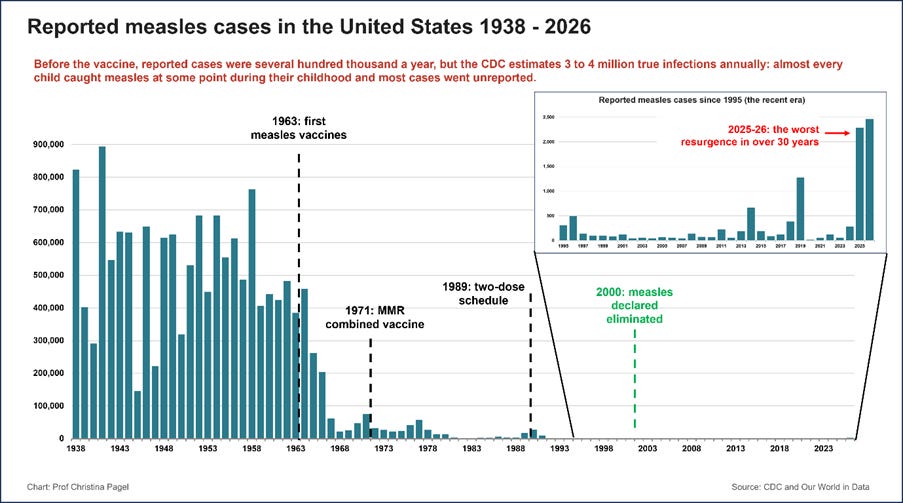
Since the introduction of the vaccine, and particularly MMR in 1971, cases fell to near-zero in the following 30 years, as did (necessarily) hospitalisations, complications and deaths. Measles was declared eliminated in the US in 2000. The assessment is due to be re-examined in November this year, and given that the last two years have seen the worst resurgence of measles in over 30 years, it is likely that the US will lose its elimination status.
Mumps
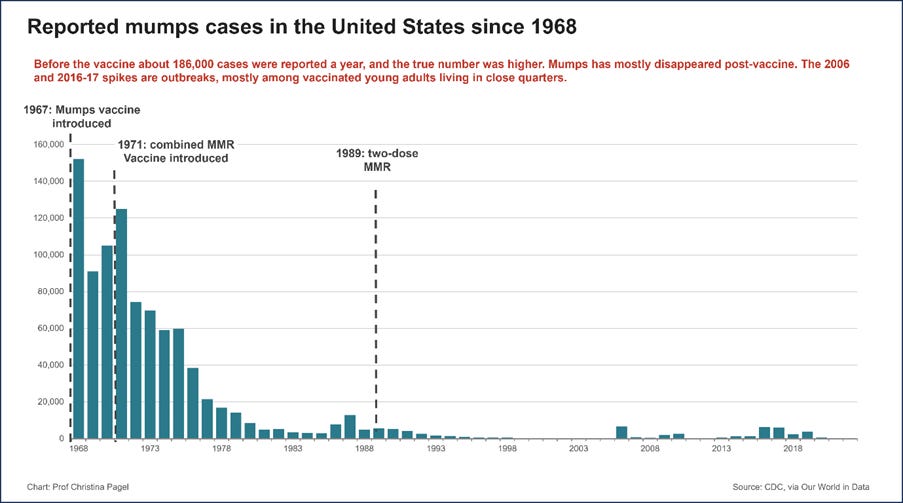
Before the vaccine, the US recorded about 150,000 cases of mumps a year. Cases fell by 99% after the introduction of MMR, although small, localised outbreaks do occur. Although deaths from mumps is rare, it can cause nasty complications particularly if first caught in adulthood. The most common is orchitis, a swollen and painful testicle, which affects about 1 in 3 unvaccinated males who get mumps after puberty. In unvaccinated females past puberty, about 1 in 14 get oophoritis (swelling of the ovaries), which settles once the infection passes. Around 1 in 25 unvaccinated people develop short-term inflammation of the pancreas (acute pancreatitis). Fewer than 1 in 10 develop viral meningitis, where the virus reaches the protective layers of the brain; this causes headache, neck stiffness and light sensitivity but usually clears within two weeks. About 1 in 20,000 people develop permanent hearing loss following mumps.
Rubella
Rubella (also known as German Measles) is usually a mild infection in children, but is more dangerous in adulthood. Up to 70% of unvaccinated adult women who get rubella can experience arthritis, but the most serious is infection in pregnancy. Infection in the first eight to ten weeks of pregnancy results in damage in up to 90% of surviving infants; multiple defects are common.
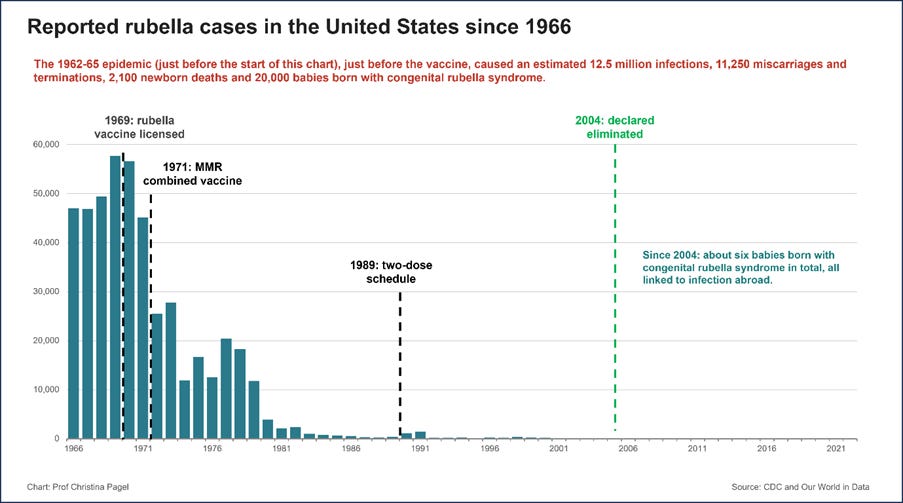
There was an epidemic of rubella in the US and Europe from 1962-65. In the US, it resulted in an estimated 12.5 million infections, 11,250 miscarriages and terminations, 2,100 newborn deaths and 20,000 babies born with congenital rubella syndrome. Cases fell rapidly after the introduction of MMR and rubella was declared eliminated in the US in 2004.
Summary
From 2000-2023, the vaccination against measles is estimated to have saved 60 million lives worldwide. From 2012-2024, the CDC estimates that Rubella vaccination has reduced cases of Congenital Rubella Syndrome in babies by 70% worldwide. These vaccines save lives and are a modern scientific miracle. The highest levels of the US administration, including the president, sowing doubt about these vaccines is incredibly harmful and it needs to stop. Now.
PS Last year, Indie SAGE produced a report on common vaccine-preventable childhood illnesses that is worth reading and sharing. You can access it here.
PPS also read Sheena’s Substack piece here & Martin McKee’s BMJ opinion here