
We are learning the wrong lesson from Covid school closures
A response to yesterday's News Agents podcast...

On The News Agents podcast yesterday, John Sopel and Lewis Goodall turned their attention to Covid while discussing the show-trial of Dr Fauci in the US senate. I wasn’t really planning on writing about Covid any time soon, but they offered two increasingly standard media pandemic takes that are simply not justified by the evidence and undermine both science and future pandemic preparedness.
Goodall and Sopel discussed school closures and the lab leak theory: “Legitimate questions have emerged and should be asked about, for example, whether school closures were a good idea or the lab leak theory itself.” Setting aside the fact that these questions have been asked continuously since 2020, they did not fairly represent the evidence.
On origins I’ll be brief because it is not my field. While a lab leak has not been disproven (and likely can never be), every piece of positive evidence that has emerged since 2020 about where the outbreak began points to a natural origin from the Wuhan wet market.
School closures are within my expertise[i]. Sopel and Goodall seem to come to the view that school closures were not justified (”I am not sure that even in the first lockdown, that school closures for any length of time were a price worth paying.”). This question is not settled - the Covid Inquiry’s Module 8 on children and young people has not yet reported and what exists right now is a media consensus.
A price worth paying implies a comparison. What was said next was that there is now “plenty of academic literature and evidence to show the damage of that on children, particularly children from the least well-off backgrounds and the most vulnerable kids”. That is true – school closures were very damaging to children – but Sopel and Goodall did not say anything about what the alternative would have been. Because the alternative is not “schools open and all other outcomes the same”.
This matters because of what comes next. What we now know about how covid affected children (and it was not as mild as commonly believed) is knowledge about one virus. The next pandemic may have a very different age profile, for instance flu pandemics have often hit the young hardest. Keeping schools open is a goal not a policy, and the lessons we need to learn are about how best to get there.
First school closures in March 2020: a price paid against what?
In March 2020, we weren’t testing, hospital admissions were doubling every 3-4 days or so, we had no treatment and no vaccine. The few countries ahead of us in the pandemic closed schools along with everything else, so we did not have evidence on the differential impact of school closures over other closures. We didn’t know that much about transmission (especially in infected people without symptoms), we didn’t know whether fewer reported cases in children was because they were less likely to be infected if exposed, if they were less likely to show symptoms (and so be less likely to be tested), or if they were less likely to be exposed because schools were shut - or a combination of all three. We had no idea about long term impacts of the virus. We did know that mixing in school and at home is an important factor in annual flu epidemics.
With hindsight, it’s plausible that with everything else shut, keeping schools open would probably still have allowed the wave to be brought under control but it would certainly have meant that it took longer to come down. We do now know that children, and schools where children mix in large numbers, absolutely do contribute to transmission. OpenSAFELY followed 12 million adults in England and found higher infection risk among those living with children. Lessler et al found the same association with in person schooling. And in Sweden, where lower secondary schools stayed open while upper secondary moved online, parents and teachers of the pupils still attending had measurably higher infection rates.
Children live with adults, and many live with vulnerable adults. They are taught by adults, including many vulnerable adults. Schools are maintained by adults, including many vulnerable adults. A longer first wave means more infections, more people in hospital, more deaths, more Long Covid. Children would have carried on attending school inside a longer lockdown. And if the numbers had not come down quickly enough, schools would have closed in the end regardless, later, with more damage already done.
Schools did reopen partially in June 2020, when community transmission was very low. With hindsight, they could probably have opened a week or two earlier if protective measures had been put in place. But we are talking days and weeks, not months (because decline is exponential just as growth was).
Summer 2020 onwards: a real failure
By the end of the first wave, we knew a lot more. But there was no government effort for education (and social) catch-ups, particularly outdoors, for children over the summer and no effort to make schools into safer environments. In September 2020, schools reopened against an airborne virus with class bubbles, staggered start times, hand hygiene and cleaning of surfaces. Masks were discouraged in classrooms. Financial support for isolation was among the least generous in the OECD, so a positive test was something many families could not afford to act on (and testing was overwhelmed that September). Ventilation was acknowledged as good practice and then barely funded: carbon dioxide monitors were not promised until August 2021 (long after the last lockdown) and then arrived late, and only 3% of classrooms had received air cleaning units by 2022.
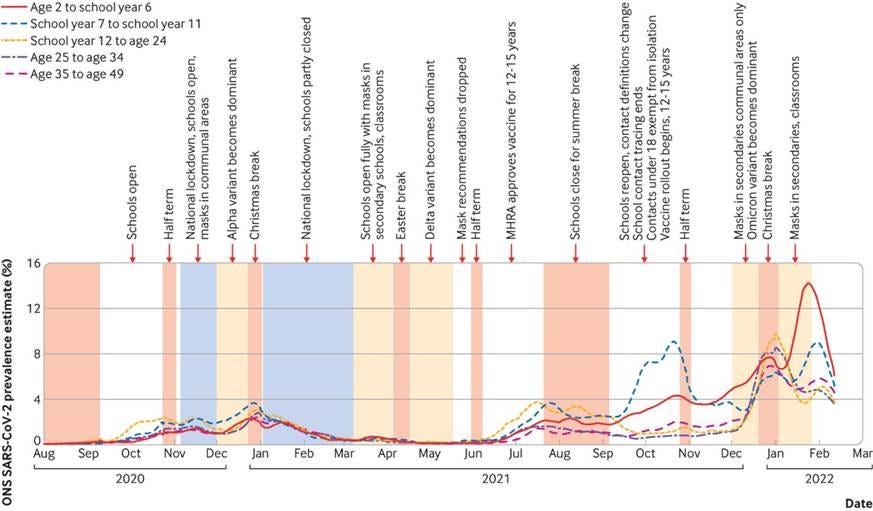
Through the autumn of 2020, schools and year groups shut repeatedly when too many staff or pupils were ill or isolating. By July 2021 (months after the last lockdown) more than a million children were out of school during the height of the Delta wave. To end the disruption, the government stopped asking child contacts of cases to isolate in August 2021. But the disruption continued throughout the autumn of 2021, as the driver became infection. By the end of 2021 prevalence was around 6% in primary and 8% in secondary pupils, and when Omicron first hit in early 2022, almost 15% of primary school children were infected in one week at its peak.
Letting the virus run through schools produced schools that partly closed, unpredictably, at no notice, with little remote provision ready. Disadvantaged children lost the most and received too little support both during and after closure.
November 2020: the lockdown with schools open
England did in fact run the experiment of lockdown with schools fully open: the second national lockdown, from 5 November to 2 December 2020. It worked but was not as effective as the first and third lockdowns. National surveillance from November found infection rates falling first in adults and then, about a week later, in children. While adults’ contacts were similar in all lockdowns, children’s contacts were markedly higher in November, when schools were open. Before the lockdown had even ended infections had started climbing again in London and the South East due to the emergence of the more transmissible alpha variant. Lockdown with schools open (and no vaccines) was simply not enough to contain the alpha variant.
From 23 November 2020 cases rose rapidly across all age groups in London and the South East. Prevalence in school age children reached levels higher than any other age group by mid-December 2020 and the December rises in children came before the rises in everyone else.
January 2021: the last and longest lockdown
Vaccination had begun on 8 December but cases were rising too fast for enough people to be vaccinated in time to either reduce spread or reduce sickness without further restrictions. I’ve already written about that devastating wave in which 87,000 people died and the NHS was brought to its knees. Modelling from the team behind the CoMix contact survey estimated that a lockdown under November conditions with schools open would have meant that R remained close to or above 1 during the Alpha wave – that would have meant a much much longer and more devastating wave. Schools – rightly – were the first things to open in March 2021.
What we now know about Covid infection in children
So far, I’ve not said anything about the impact of Covid infection on children. Media consensus again seems to be that it is minimal. It is not. Children can be at lower risk than adults and still be at risk. Note that much of the evidence I’m going to talk about in this section was consolidated after 2021, after decisions on schools had to be made.
In our study analysing a national cohort of 3.2 million children in England, published in 2023, there were 29,230 hospital admissions associated with a first covid infection. Covid was the cause of, or a contributory factor to, 21,000 of them. 1,710 involved paediatric critical care. There were 70 deaths in which covid or PIMS-TS was listed as a cause. Hospital admissions were disproportionately in children from the most deprived areas and from minority ethnic backgrounds, the same children who bore the heaviest costs of school closure.
PIMS-TS, a dangerous inflammatory syndrome that could attack children several weeks after infection, was described for the first time in May 2020, during the first wave. It is rare: in England, during the January 2021 wave, it was estimated at roughly one in 2,600 infections in children but it is serious. Of the 1,790 children admitted with it in our cohort, 30% needed intensive or high dependency care, the highest proportion of any category of admission we looked at.
Then there are the children who develop Long Covid. It is hard to measure (especially as Covid infections in children are more likely to be either ‘non-typical’ symptoms or asymomptatic and so are often missed) and so there are a wide range of estimates for how common it is. I will use conservative figures from high quality studies. Among adolescents, the CLoCk study matched those who tested positive against those who tested negative and found, three months later, 30% of children with Covid infection had three or more persistent symptoms vs 16% of those with no confirmed Covid infection. The comparison group lived through the same pandemic and the same school disruption, so that gap of roughly 14 percentage points is an excess attributable to infection.
The ONS Schools Infection Survey estimated that 1.8% of primary and 4.8% of secondary pupils had symptoms lasting at least twelve weeks after a positive test that affected their daily life. Among adults, the REACT programme’s study of 242,712 people, compared against people who had never been infected, put persistent symptoms at 7.5% at twelve weeks and 5.2% at a year, and found longer durations for infections acquired when the original variant was dominant in 2020. That is exactly the variant a first wave mass infection event would have involved.
And more than 16,000 children in the UK lost a parent to covid.
This idea that we could have simply kept schools open, without changing anything else, and all would have been fine is just not supported by the evidence.
So what are the lessons?
We need to build a system in which we do not need to close schools (and even then, a virus may emerge that makes this impossible). Evidence from Covid did find that schools with better mitigations had lower infection rates than those without.
I suggest six key learning points.
1. Do not prejudge the next pandemic. Everything in the section above is knowledge about SARS-CoV-2 (coronavirus). It says nothing at all about what the next pandemic virus will do. Influenza pandemics have often hit the young hardest (e.g. 1918 or 2009). Turning “covid was milder in children than adults” into “never close schools” is fundamentally stupid.
2. Clean air as infrastructure. Ventilation and air quality standards in school buildings, should be funded and built before the next airborne pandemic rather than procured in a panic during it. This will make it easier to keep children in school during an airborne pandemic, while having a whole host of other benefits on child health and learning in normal times.
3. Invest in effective public health measures. Open schools are an outcome, and to get there we need cleaner indoor air, excellent community testing and contact tracing, generous support for isolation and a host of other public health measures including early action to suppress growth.
4. Support children in disadvantaged communities, funded in advance. This includes devices, connectivity, food, safe spaces to learn, and the staff to deliver catch up. The unequal impact of the pandemic on children was inherited from our ongoing deep structural inequalities.
5. Mental health and social support during school closures designed in from day one. If school closures do become necessary, have a planned and strong roll-out of measures to support mental health and social contact. The ongoing technological revolution should make this easier.
6. Build the capacity to generate evidence faster next time. It took years to establish what covid did to children and how much schools contributed to transmission. Surveillance and study designs that can deliver that within months, rather than years, would support schools to stay open during pandemic waves, because they are what tells us how to do it.
[i] I’ve published quite a bit on children and covid including: a peer-reviewed BMJ analysis of how UK policy on children and schools related to the evidence available at each point; a peer-reviewed BMJ cohort study of 3.2 million children in England examining who was admitted to hospital with Covid and why; a short piece on Long Covid in Children for Lancet Child & Adolescent Health.
I suggest The News Agents invite you on to correct the record. You were my go to source for reliable research, analysis and updates on Covid throughout the pandemic.
Thanks for providing a thorough and fully referenced response to yesterday's "Newsagent's" ill-considered statements about school closures during the Covid epidemic. I was extremely disappointed with Goodall and Sopel's simplistic conclusions about an issue which is clearly complex and nuanced.